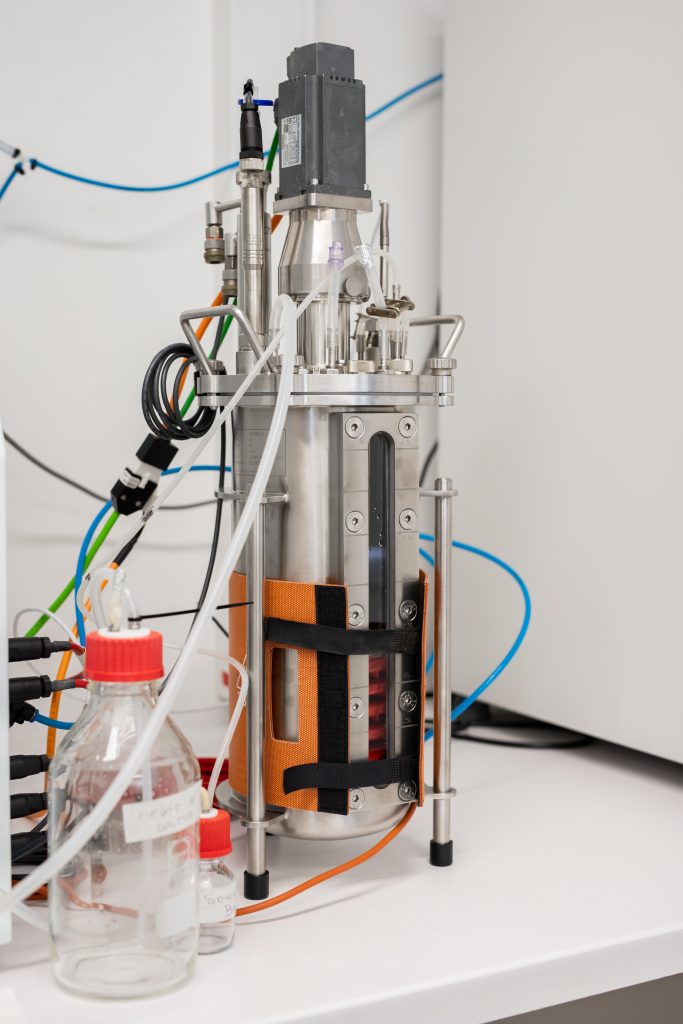

Biotechnology is not a new discipline, but it is advancing at an exponential pace and has an increasing number of applications for obtaining products that will be used by humans in human and animal health, such as antioxidants and anti-inflammatory compounds; the chemical industry, such as enzymes; fermentation industries, such as alcohols; agriculture and food, such as biocontrol agents and colorants; the environment, such as pollutant-degrading agents; energy production, such as biofuels; and the pharmaceutical industry, such as antibiotics.
Biotechnology makes it possible to optimize processes that occur in nature for industrial use in a sustainable way. This makes bioreactors key to its implementation.
But what exactly are bioreactors?
Bioreactors are closed cylindrical pieces of equipment, made of stainless steel or glass, with working volumes ranging from milliliters to cubic meters, progressing through laboratory, pilot, and production scales depending on the bioprocess. These systems are developed with technology that allows them to withstand high pressures and temperatures in order to achieve a sterile environment.
They also provide optimal conditions for the cultivation of microorganisms and are capable of maintaining a biologically active environment. Environmental conditions such as gas flow, for example oxygen, nitrogen, carbon dioxide, etc., temperature, pH, dissolved oxygen, and agitation or circulation speed must be carefully monitored and controlled.
So, what is the function of bioreactors?
The bioreactor–culture system must support the growth of microorganisms, such as bacteria, fungi, and yeasts; plant cells; microalgae; and animal cells. It must keep cells uniformly distributed throughout the culture volume, maintain a constant and homogeneous temperature, minimize nutrient concentration gradients, prevent sedimentation and flocculation, allow gases and nutrients to diffuse at the rate required by the culture, maintain an aseptic environment, maximize yield and production, minimize production costs, and reduce processing time as much as possible.
Why are they important in biotechnology?
Bioreactors generate precise and efficient results in cell cultures or microbial fermentations thanks to their different operating modes. With them, it is possible to investigate multiple operating variables, improve culture conditions, and even discover new metabolites of interest. In this way, research can obtain results that have not been previously observed or studied, generating solutions that address human, environmental, or other needs, such as the production of industrial enzymes or bacteria capable of producing biodegradable plastics.
The advancement of knowledge enabled by bioreactors has not only been seen in cell biology, but also in the food industry, where it is now possible to cultivate meat, as well as other foods that are becoming threatened due to climate change. Therefore, it should not be surprising that, in the near future, the world’s population may be fed thanks to bioreactors.
A futuristic idea today, but we do not know what may happen tomorrow. Do you think it is possible?